
Incense Village history begins with a working craft
Incense Village history at Quảng Phú Cầu reaches back to the early twentieth century. A government account published in January 2025 places the beginnings of the local trade in those early decades and describes skills passed down over more than a century. This gives the visit a longer perspective than the colourful photographs alone. Look at the bundles as work with a history, shaped by households and changing tools.
The community lies south of Hanoi and remains known to visitors as Quảng Phú Cầu. Its story involves bamboo cores, finished incense, family livelihoods and religious use. Rather than seeking a single founding moment, notice how those elements connect. The craft village guide explains the production stages in more detail and helps place what you see in the workshops.
Craft settlements and Xà Cầu
The government account names Phú Lương Thượng, Phú Lương Hạ, Xà Cầu, Đạo Tú, Cầu Bầu and Quảng Nguyên within this craft landscape. Xà Cầu is associated with black incense, while the other named settlements are associated with bamboo sticks. This distinction is useful when someone describes the whole area simply as an incense village. Different households and places contribute different forms of work.
For a visitor, the practical starting point is the family or courtyard on the itinerary. Ask how that household's work fits into the larger craft community and which product it makes. A guide can help connect the visible steps with their purpose. This is more informative than assuming that every colourful courtyard carries out all stages or that all the settlements specialise in the same finished item.
Our pick: visit artisan homes
This private-transport visit includes artisan homes and historical explanations from the guide.
Hand-picked tours, booked through GetYourGuide. Prices are indicative starting prices in US dollars (as of October 2026). Tap a tour for live availability and the current price in your currency.
Visit workshops with historical explanations
The private incense and hat village outing includes artisan homes, a guide, admission and time for photographs.
Bamboo cores and finished incense
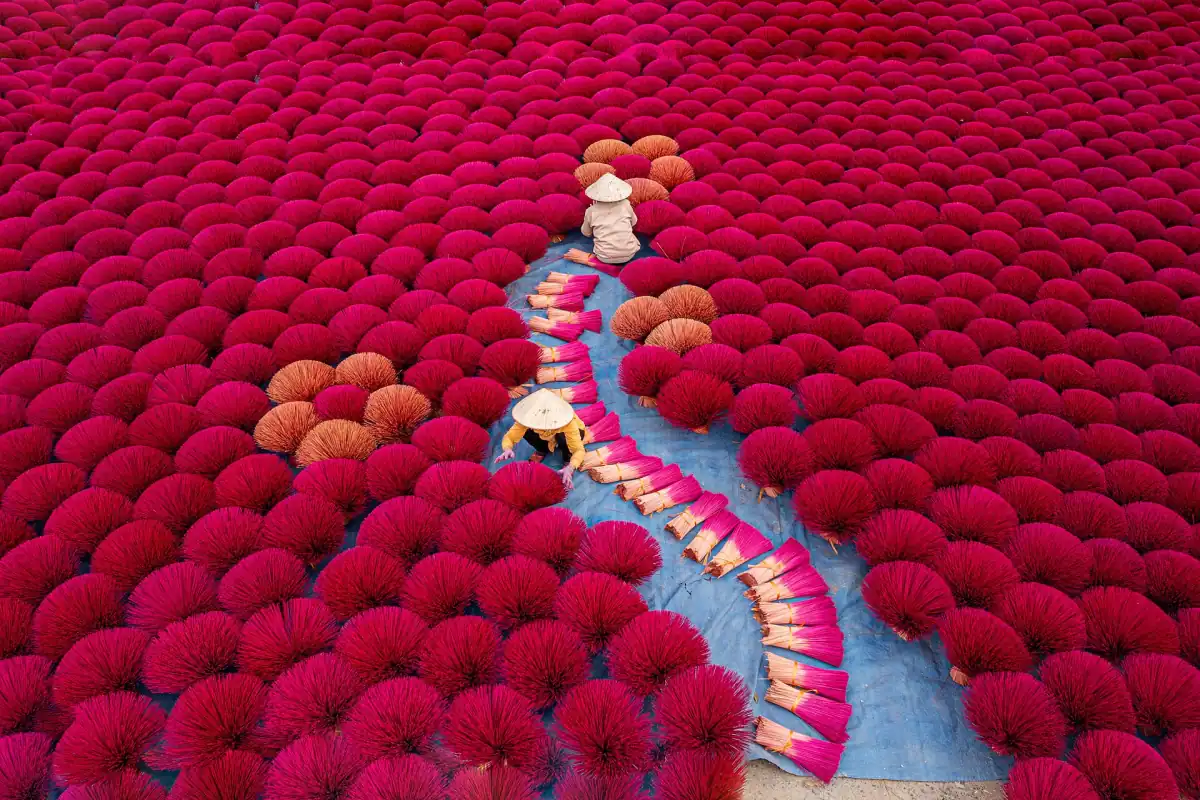
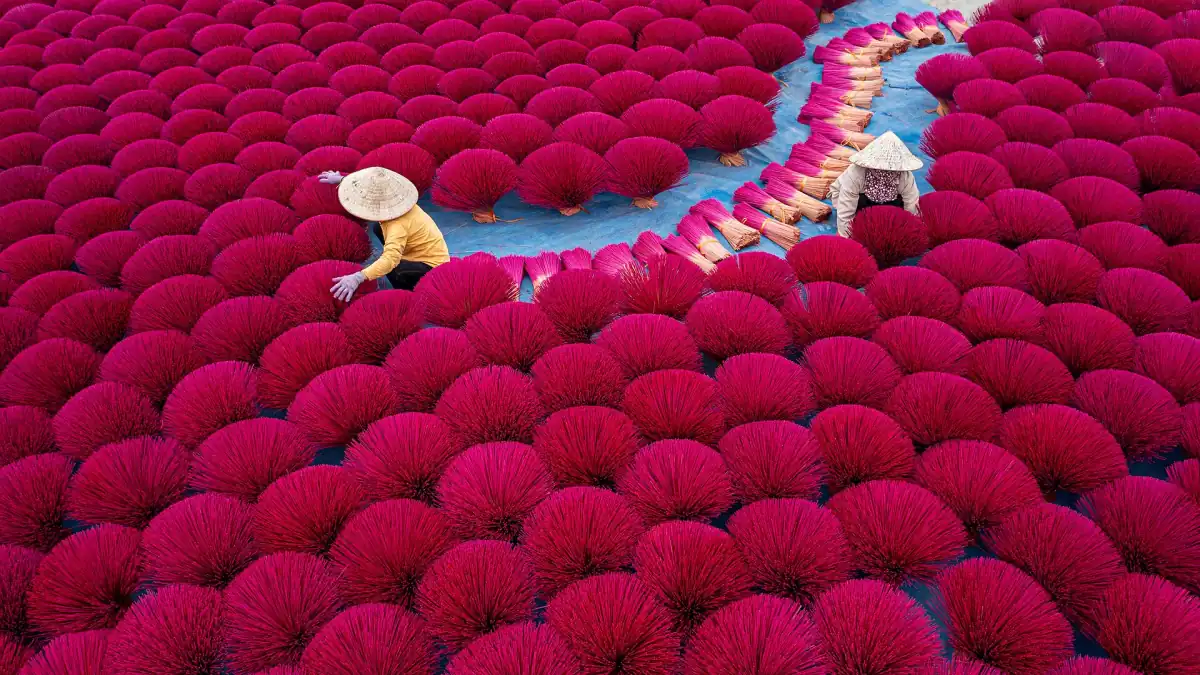
The bright sticks spread out to dry can be bamboo cores rather than finished incense. A December 2025 report describes splitting bamboo, colouring, sorting and packaging, with drying taking place in courtyards, lanes and shared open spaces. Red is familiar in photographs, while the same report also describes yellow and green bundles. Look closely at what is being handled rather than letting colour stand in for the whole craft.
The distinction between core and final product changes how you read the courtyard scene. Ask whether the sticks have been coloured, are drying or have reached a later stage. The making process gives a photograph a clearer subject, and the explanation helps you understand why materials are laid out in particular ways. For a visit centred on those pictures, see the photography outings.
Family skills and mechanisation
A newspaper feature from November 2023 described bamboo being split into thin sticks, dried, then machine-rounded and polished. Read this as a historical observation of the work at that time. It shows that the craft story includes machinery as well as manual skill. The continued role of families does not require the production process to remain unchanged in every generation.
The December 2025 reporting describes the trade as a family occupation passed down through generations. Sorting, colouring and packaging help explain the human work visible around the bundles. When you visit, let the household describe its own methods. Different tools, materials and products belong within a living craft tradition. They make the story more specific than a general claim that everything follows one method or recipe.
Religious life and the approach to Tết
Incense belongs to Vietnamese religious and family customs. That connection helps explain why the work matters beyond the photographic courtyard. The December 2025 report links busy production before Tết to the approaching lunar new year. The craft therefore has a practical place in the calendar of family and religious life, as well as a visual presence for visitors.
When choosing your date, use the seasonal planning guide to connect that production cycle with weather and photography. During a visit, allow people to continue their work. Ask permission before workshop photographs or portraits, and discuss posed scenes separately. Taking the craft's purpose seriously makes the historical visit more rewarding than treating a working space only as a backdrop.
Tourism and the administrative change in 2025
The January 2025 government account describes Hanoi's recognition of the craft village as a tourism destination and the programme Quảng Phú Cầu: Life and Colours. Later in 2025, the administrative reorganisation placed the former commune within Ứng Thiên, formed with Hòa Viên, Trường Thịnh and Liên Bạt. The visitor name Quảng Phú Cầu continues to identify the craft community, while Ứng Hòa remains useful historical and geographical context.
To connect this background with a visit, the featured private incense and hat village outing includes historical and cultural explanations, artisan homes and workshops, admission and photo time. It lasts 4.5 hours, with private transport, an English-speaking guide and Old Quarter hotel pickup; lunch is separate. Compare the route on the private tours page if you want to spend the outing following both the craft and the people who explain it.
Questions before your visit
When did the local craft begin?
The government account places its beginnings in the early twentieth century. It describes a tradition passed down over more than a century.
Are the coloured bundles finished incense?
They can be coloured bamboo cores. Ask which production stage the household is showing you.
Can a visit include historical explanations?
The featured private incense and hat village outing includes cultural and historical explanations from a guide, as well as artisan homes and workshops.